

Red Light Therapy: The Skincare Trend Backed by Science—With a Few Caveats
If
your
skincare
routine
is
starting
to
resemble
a
scene
from
a
sci-fi
film—glowing
masks,
high-tech
gadgets,
a
faint
red
hue
lighting
up
your
bathroom—you’re
not
alone.
Red
light
therapy
has
quietly
moved
from
dermatology
clinics
into
everyday
routines,
promising
smoother
skin,
fewer
breakouts,
and
that
elusive
“lit-from-within”
glow.
This
LED
light
therapy
is
non-invasive,
painless,
and
increasingly
accessible.
But
while
it’s
easy
to
get
swept
up
in
the
aesthetic,
what
really
matters
is
whether
red
light
therapy
works—and
what
kind
of
results
you
can
realistically
expect.
What
is
red
light
therapy?
At
its
core,
red
light
therapy
(also
known
as
photobiomodulation)
uses
low
levels
of
red
or
near-infrared
light
to
penetrate
the
skin.
Instead
of
exfoliating
or
resurfacing,
it
works
at
a
cellular
level—stimulating
energy
production
and
encouraging
repair.
Dermatology
research,
including
findings
from
institutions
like
the
Cleveland
Clinic
and
Harvard
Health
Publishing,
suggests
red
light
therapy
can
boost
collagen,
improve
circulation,
and
reduce
inflammation.
The
key
is
consistency—it’s
less
about
quick
fixes
and
more
about
steady,
cumulative
improvement.
Benefits
of
red
light
therapy:
Softening
fine
lines
and
improving
skin
texture
—
collagen
support
helps
skin
look
firmer
and
more
even
over
time,
with
subtle,
gradual
results.
Reducing
redness
and
calming
mild
acne
—
its
anti-inflammatory
properties
help
soothe
irritation
and
visibly
quiet
the
skin.
Supporting
healing
and
recovery
—
often
used
after
treatments
because
it
can
encourage
faster,
more
efficient
skin
repair.
Enhancing,
not
replacing,
your
routine
—
think
of
it
as
a
long-term
addition,
not
a
substitute
for
injectables,
lasers,
or
prescription-strength
skincare.
All
of
which
sounds
compelling—and
it
is—but
understanding
the
limitations
of
red
light
therapy
for
skin
is
just
as
important
as
knowing
the
benefits.
What
to
know
before
trying
red
light
therapy:
The
research
behind
red
light
therapy
is
promising,
but
still
evolving.
Many
studies
are
relatively
small,
and
results
can
vary
depending
on
the
device
and
how
consistently
it’s
used.
That
distinction
between
devices
matters
more
than
most
people
realize.
In-office
red
light
therapy
treatments
are
significantly
more
powerful
than
at-home
LED
devices,
which
is
why
results
tend
to
appear
faster
in
a
clinical
setting.
There
are
also
a
few
nuances
worth
noting.
Some
dermatologists
caution
that
heat
generated
by
certain
devices
may
aggravate
conditions
like
melasma,
particularly
in
deeper
skin
tones.
And
while
it
may
feel
low-effort,
it’s
still
a
light-based
treatment—meaning
proper
use,
including
eye
protection,
is
essential.
How
to
try
red
light
therapy
at
every
price
point:
One
of
the
reasons
red
light
therapy
at
home
has
taken
off
is
the
range
of
ways
you
can
incorporate
it
into
your
routine.
In-office
treatments
are
the
most
intensive.
Typically
performed
at
dermatology
clinics
or
medical
spas,
they’re
often
paired
with
procedures
like
facials
or
microneedling
for
more
noticeable
results.
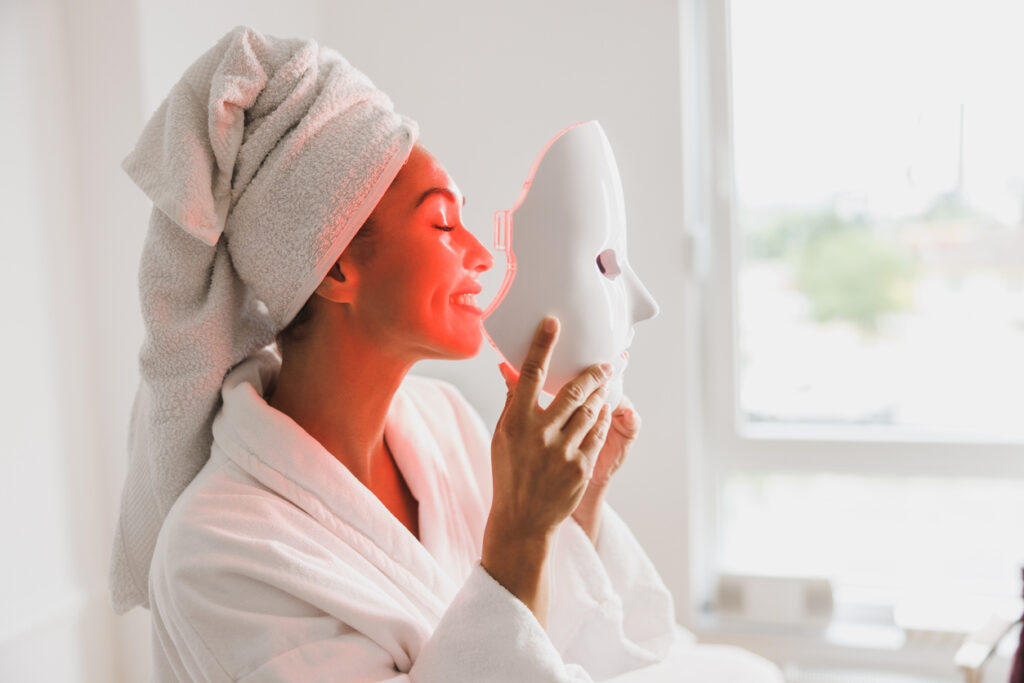
At-home
LED
masks
are
the
most
popular
option
for
convenience.
While
they
require
an
upfront
investment,
they
make
consistency
easier—which
is
key
for
seeing
results
with
red
light
therapy.
Handheld
devices
and
light
panels
offer
a
more
flexible,
often
more
affordable
entry
point.
They
can
be
effective,
but
require
a
bit
more
patience
and
regular
use.
Red
light
therapy
sits
comfortably
between
skincare
and
technology:
not
essential,
but
genuinely
effective
when
used
consistently.
It
won’t
transform
your
skin
overnight,
but
over
time,
it
can
leave
it
looking
healthier,
calmer,
and
more
refined.

